
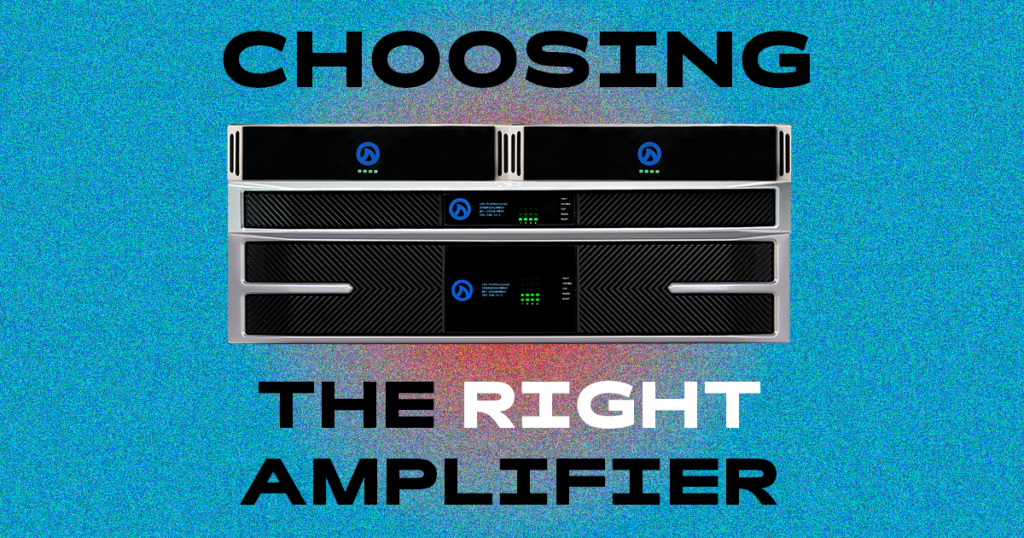
There is a multitude of amplifiers on the market, varying widely in wattage rating, size, channel count, and more. Wading through all of the specifications can be time-intensive. You can’t compare products from different manufacturers easily because they often measure their specs using varying attributes (e.g., idle vs. ⅛ power vs. ⅓ power, etc.).
Choosing the right amplifier for each installation is a key aspect of every system design. An improper choice can lead to signal clipping, loudspeaker damage, overheating, or simply an unsatisfactory audio experience. Here are some criteria to consider when choosing an amplifier for your next job.
Hi-Z/Lo-Z Support
Hi-Z and Lo-Z are designed for different applications. Hi-Z is for distributed applications requiring many loudspeakers for adequate coverage but without the need for a concert-level experience. In contrast, Lo-Z applications are primarily about higher fidelity requirements for when you need to reproduce the rumble of the dinosaur’s foot hitting the ground or the bass guitar or kick drum in a concert.
While the system design typically calls out the type of loudspeaker (Hi-Z or Lo-Z) in advance of buying system components, being able to select Hi-Z or Lo-Z output on a per-channel basis provides integrators with a lot of flexibility should something change in the design mid-stream. Additionally, there are several scenarios where an end user may have a higher fidelity requirement in a space adjacent to one requiring a distributed speaker solution, so having an amplifier that can support both requirements can be very advantageous
Wattage, wattage, wattage
There are several ways for loudspeaker manufacturers to specify wattage — program, RMS, and peak, to name a few. Plus, the test attributes for achieving the stated ratings vary as well, so check the footnotes on data sheets to ensure you’re comparing apples-to-apples between different manufacturer’s loudspeakers.
That said, the continuous or RMS and peak values are of primary interest when selecting an amplifier. You should always match the continuous rating to the amplifier rating. For example, if you specify a 300-watt continuous speaker, you want to specify at least a 300-watt per channel amplifier. That doesn’t provide any headroom for peak signals, though. Typically, having 20% headroom in additional wattage is good practice because it allows for better dynamic range. For Lo-Z applications where audio fidelity is paramount, you’ll want to hit both the continuous and the peak or maximum ratings of that loudspeaker.
System Monitoring
Once the system is installed and commissioned, uptime becomes the priority. Monitoring the system to prevent issues from occurring or handling them quickly is a priority for the support team, whether onsite or remote. By monitoring AV equipment remotely, organizations can potentially reduce the need for onsite technician visits and service calls, which leads to cost savings in travel expenses, labor, and time.
Remote monitoring — especially cloud-based services — is scalable, making it suitable for organizations with multiple locations or a widespread AV infrastructure. It allows technicians to oversee and manage numerous AV setups from a centralized location, ensuring consistency and control. Perhaps the most significant benefit of remote monitoring is the peace of mind it provides to end customers. Since many houses of worship use volunteer-based AV operators, having expertly trained technicians working behind the scenes can help tremendously.
Technical Support
Not all manufacturers are created equal — the adage “you get what you pay for” applies to purchasing amplifiers. Too often, amplifiers are value-engineered because “it’s just an amp.” But they aren’t — they’re equally important to the audio system as other components. Whether during commissioning or post-installation, if something goes wrong with the system in general or one of the amps in particular, you may need to lean on the manufacturer’s technical support teams to help troubleshoot the problem. It’s worth investigating the manufacturer’s stance on technical support to see if you’ll be set up for success should something go wrong.
Final Thoughts
Many people in the pro AV industry consider amplifiers to be commoditized products with few differentiators. Often the first component “value engineered” in the audio system, the problem with value engineering is that it only considers present cost/investment and not the total cost of ownership over the life of the installation. Amplifiers play an important role in speech intelligibility and music clarity, and a wide gamut of products that span cost and ability are available. Choosing the right amplifier, which a manufacturer backs with solid post-sales support infrastructure, will lead to fewer problems and truly engaging worship experiences.