

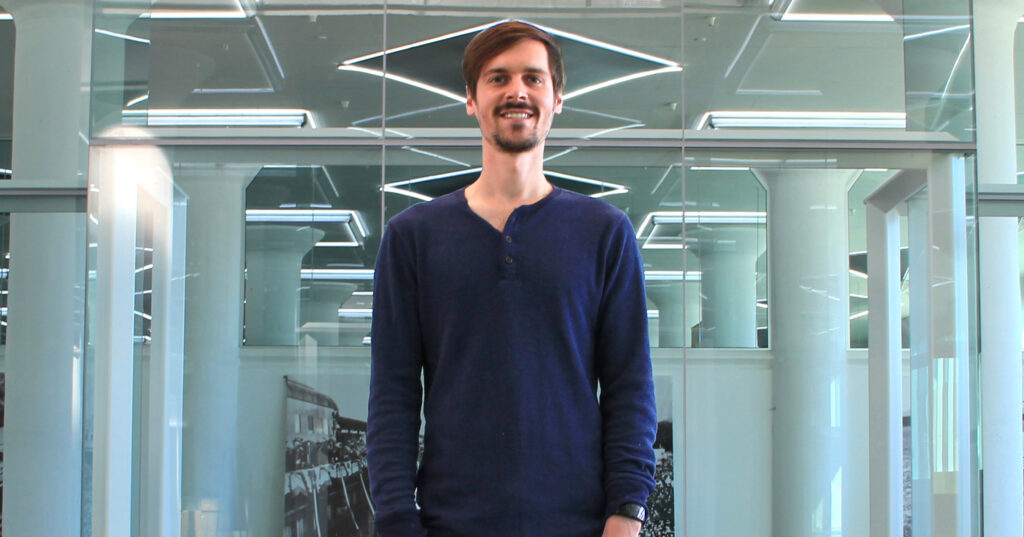
LEA Team Spotlight: Principal Analog Hardware Engineer, Josh Stump:
One of our goals as a new company rising into a well-established industry is to always remain transparent. From our product development to the glass walls of our office – we have such a strong belief in our vision and our ideas, that we aren’t afraid to bring everyone else along to ride the wave with us.
In the spirit of transparency, we are happy to introduce you to our Principal Analog Hardware Engineer, Josh Stump!
Josh got his start in engineering as a kid, taking apart electronics to see how they work – and sometimes, putting them back together. He got his degree in Electrical Engineering from Purdue University and during his schooling, started an internship with Crown Audio that led him down the signal path in pursuit of perfect audio. Now, Josh is one of the many talented engineers working tirelessly to bring the LEA vision into existence with our first amplifier series, the Connect Series.
What’s your current position at LEA? What are your daily duties and long-term roles?
[JS] Principal Analog Hardware Engineer. A professional power amplifier is typically built with different modules. I have taken over the role of PCB (printed circuit board) designer of the “Power Module” including the power supply, and the actual amplifier (Switching Stage) itself.
Another role I am responsible for is amplifier validation. Amplifier validation includes designing and building a unique piece of test equipment called a resistive load. This specialized equipment tests power numbers, frequency response, stability, and more by delivering a precise, low inductance, high power, variable load.
The nuances of PCB design are numerous. Understanding how to layout a PCB in order to pass all our safety regulations alone would take pages of design techniques. Variables like trace thicknesses, noisy circuit isolation, and bypass capacitor layout are just the tip of the iceberg. Understanding all these techniques and using them to layout a PCB that not only works but makes sense, is a skill that I possess as the Principal Analog Hardware Engineer.
What is your background in the pro audio industry?
[JS] I went to Purdue for Electrical Engineering. Then, I started an internship at Crown immediately following my freshmen year in college. Crown’s top analog design engineer, Ben Carroll, was my mentor.
I trained extensively in analog hardware engineering and good PCB layout practices, EMC (electromagnetic compatibility) design/troubleshooting, and amplifier validation techniques. A portion of my time was spent creating myself, or mentoring COOP’s to create automation testing.
How has your background prepared you to help LEA be successful and compete in our industry?
[JS] I spent almost 9 years at Crown, gaining insights into this industry, and learning what it meant to work for such a large corporation. I can sum up this advantage in 2 points:
- Harman was massive. Almost by definition, this meant a lot of bureaucracy. I’m not saying it was all bad, but it did without a doubt slow us down. Here at LEA, we can be nimbler, but we understand where not to cut corners. We’ve seen the processes that are truly important and can optimize them in order to achieve what we really want – which is an extremely reliable, powerful, sexy amplifier.
- After nine years at a company, you get to know what you are really selling, and what your customers desire. No doubt price point is important. I know this team can create an amazing amplifier that outshines the competition at an unbelievable price point. Besides that, I’ve felt and seen a desire for quality like no other.
This drives me to make sure our new amplifier series, and the ones to come, will not only meet these standards of reliability but far exceed them. One day “LEA” and “Reliable” with being synonymous, and I will be a part of the team that makes it so.
What is it that you like about audio technology?
[JS] Audio technology takes my two passions and puts them together – audio and technology! It doesn’t get any better.
I grew up taking electronics apart, trying to understand what was going on inside them. Sometimes I would even put them back together! As I was doing this, I would have my Sony Walkman CD player blaring Coldplay. Fortunately, now that I design power amplifiers as an analog hardware engineer, even if I lose hearing, I will always have a backup plan. 

What was the most complicated or fun thing for you to take apart and put back together?
[JS] When I was younger, I did more destroying than fixing in my adventures in taking apart things. However, a couple years ago my wife broke her iPhone screen. That was by far the most complicated thing I have taken apart and fixed. The easy way to do it is to buy the glass with the LCD and digitizer and camera and microphone all assembled. Unfortunately, that cost more than buy a kit that made you salvage parts from the old phone.
I’m used to working with small stuff, but the cables inside that phone were delicate, and most of them were glued down. It took me 30 minutes, and when I finished, I couldn’t believe it worked! I have a lot of faith in my abilities, but if you have ever taken apart a phone, when you get it back together and it actually works as intended, sometimes you can’t help but being a little amazed.
What is the most exciting thing about joining LEA and the work you are doing?
[JS] The team. What we are doing is exciting, and extremely fulfilling for me. But who I am doing it with is by far the most enjoyable. Every day I get to come to work and hang out with people I enjoy and have fun with. At times (arguable all the time) we are working extra hours getting our work done and keeping our heads down. Even so, we still have fun. I’m very blessed to be working with these individuals.
What are your personal hobbies or what do you like to do in your downtime?
[JS] I have two kids, and one thing I learned quickly about kids is that hobbies/downtime gets significantly cut back. So currently, my main hobby is loving on those little guys. However, with my remaining time I like to run, listen to audiobooks and tinker around with side projects (building my own CNC, wireless light switch, eggbot, etc.).
Can you elaborate on the wireless light switch and eggbox?
[JS] Several years ago, before wireless outlets were commonplace and cheap, I wanted my own. And I wanted it to work a little differently. I wanted a normal light switch to turn on and off an outlet that the switch without being hardwired. In addition, I wanted to control the same outlet with my phone. So, I based everything on an Arduino (a cheap open source development platform), tacked on a Bluetooth receiver so I could control it with my phone, and tacked on a wireless transceiver so I could wirelessly control it with a normal light switch. I made a prototype and programmed it and it worked!
My goal was to then shrink it down to a package size that would make sense, but life got in the way. Maybe someday, but I’m pretty sure they have things that do this on the market now.
[JS] The eggbot is basically a glorified egg/spherical object, decorator. Somebody developed these mini CNC egg decorators and released open-source designs of them. You can buy assembled ones or kits, but again, I’m cheap, and I own a 3D printer (actually the one in our lab) so I made my own. I designed a PCB that plugged into an Arduino and wired everything up.
I’m 90% done with this project. All that’s left is tidying everything up.
The analog hardware found in LEA Professional products is crucial to the design. If you have any questions about Josh’s role as Principal Analog Hardware Engineer or the Analog Hardware found in LEA Professional products, ask us in the comments below.



Comments are closed.