If you are familiar with the Crossover settings within our Web UI and Cloud platforms, you will know that we offer three crossover filters; Butterworth, Linkwitz-Riley, and Bessel.
These three filters have existed in audio processing for decades and have become industry standards for configuring audio crossover frequencies.
These filters are known as IIR filters or Infinite Impulse Response filters, due to the feedback present in the filter. They provide the benefit of shorter delay times to achieve linear phase response.
But, what are the differences between each filter type?
Let’s dive in and find out…
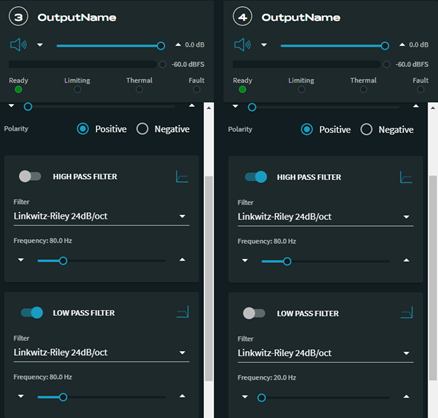
For context, the following examples shown for each crossover type were derived by capturing the output response of our Connect Series amplifiers, after applying the settings within the Web Ui.
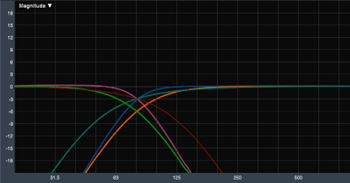
Each example is using a 24dB/Oct slope at 80Hz, settings similar to this are commonly applied when using a “top box” in conjunction with a subwoofer.
Setting crossover filters like this gives each speaker in a system a specific frequency range to reproduce, this range should be set to where the speaker was designed to operate, this will result in higher efficiency and increased headroom. Properly implemented crossover filters allow for separate speaker enclosures with dedicated frequency ranges to operate seamlessly together across the audio spectrum as if they were one big speaker.
A Butterworth filter is a type of digital signal processing filter that offers a flat frequency response in the pass-band and zero roll-off response in the stop-band. They can also be known as Maximally Flat Filters or Flat-Flat filters due to the relatively flat frequency response they offer.
The result of this type of filter is a more linear phase response than alternative filters which results in better group delay performance and a lower level of overshoot making it an ideal filter for high-quality audio applications
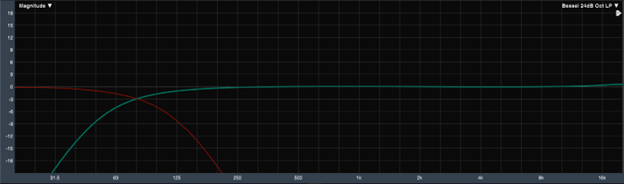
Bessel filters are also known as the “Maximally Linear Phase” filter. These filters are designed to let a few boosts and dips enter the pass band, with the overall goal of minimizing the group delay to keep it as consistent as possible.
This type of filter provides a frequency response that works well for applications that require constant group delay such as analog video signal processing.
While a Butterworth filter will have a 3dB peak at the crossover point, and a Linkwitz-Riley will be flat, the Bessel filter falls just in between those.
A Bessel filter does not maintain a linear phase response at higher frequencies, but of the three filters (Bessel, Butterworth, and Linkwitz-Riley) it has the most linear phase.
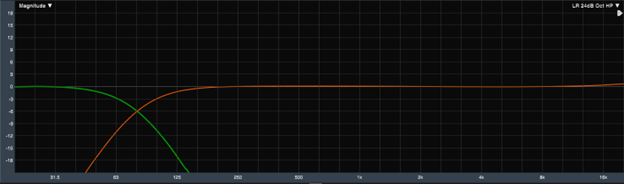
A Linkwitz-Riley filter uses a parallel combination of low-pass and high-pass filters which results in zero gain at the crossover frequency. Because of the zero gain at the crossover frequency, a Likwitz-Riley filter behaves like an all-pass filter delivering a flat amplitude response and a smooth changing phase response.
A Linkwitz-Riley filter is made by combining two Butterworth filters.
The main difference between the two is that Butterworth crossovers are 3dB down at the filter cutoff frequency while the Linkwitz-Riley filters are flat.
In the plot above you can see the differences between each of the filter types by referencing the trace colors from the previous plots.
The plots within this document intentionally only display the magnitude differences of each filter, as mentioned previously they also have differences in phase response and group delay, that conversation is outside the scope of this document.
The selection of proper crossover filters is generally determined by the performance of individual speaker elements, those elements need to be controlled in a manner that ensures they interact in a way that achieves the combined desired outcome from a frequency and phase response perspective.
Through the proper use of crossover filters, individual speaker elements perform in a manner that allows them to become a “system”, with proper planning crossovers can be implemented in ways that allow for individual speaker models within a system to have similar tonal characteristics and phase response, which allows for easier integration of additional speaker models into the system, with very little action needed by the end user.
If you have any questions or feedback about, feel free to fill out the form below or reach out to us on our social media channels.
Want more LEA content delivered directly to your inbox? Enter your email address below to be subscribed to our monthly newsletter and keep up with all of the latest news and content from LEA Professional.
This website uses cookies to improve your experience. We'll assume you're ok with this, but you can opt-out if you wish.AcceptRejectRead More
Privacy & Cookies Policy
Privacy Overview
This website uses cookies to improve your experience while you navigate through the website. Out of these, the cookies that are categorized as necessary are stored on your browser as they are essential for the working of basic functionalities of the website. We also use third-party cookies that help us analyze and understand how you use this website. These cookies will be stored in your browser only with your consent. You also have the option to opt-out of these cookies. But opting out of some of these cookies may affect your browsing experience.
Necessary cookies are absolutely essential for the website to function properly. This category only includes cookies that ensures basic functionalities and security features of the website. These cookies do not store any personal information.
Any cookies that may not be particularly necessary for the website to function and is used specifically to collect user personal data via analytics, ads, other embedded contents are termed as non-necessary cookies. It is mandatory to procure user consent prior to running these cookies on your website.