Why You Need PFC (Power Factor Correction) In An Amplifier
Ok, you don’t really need to have Power Factor Correction (PFC) in your amplifiers. But generally, if you’re designing a sound system, PFC amps can save you a lot of trouble. So then, what is PFC anyway and why is it so important? Well, let me tell you…
What is PFC or Power Factor Correction?
Why You Need PFC (Power Factor Correction) In An Amplifier
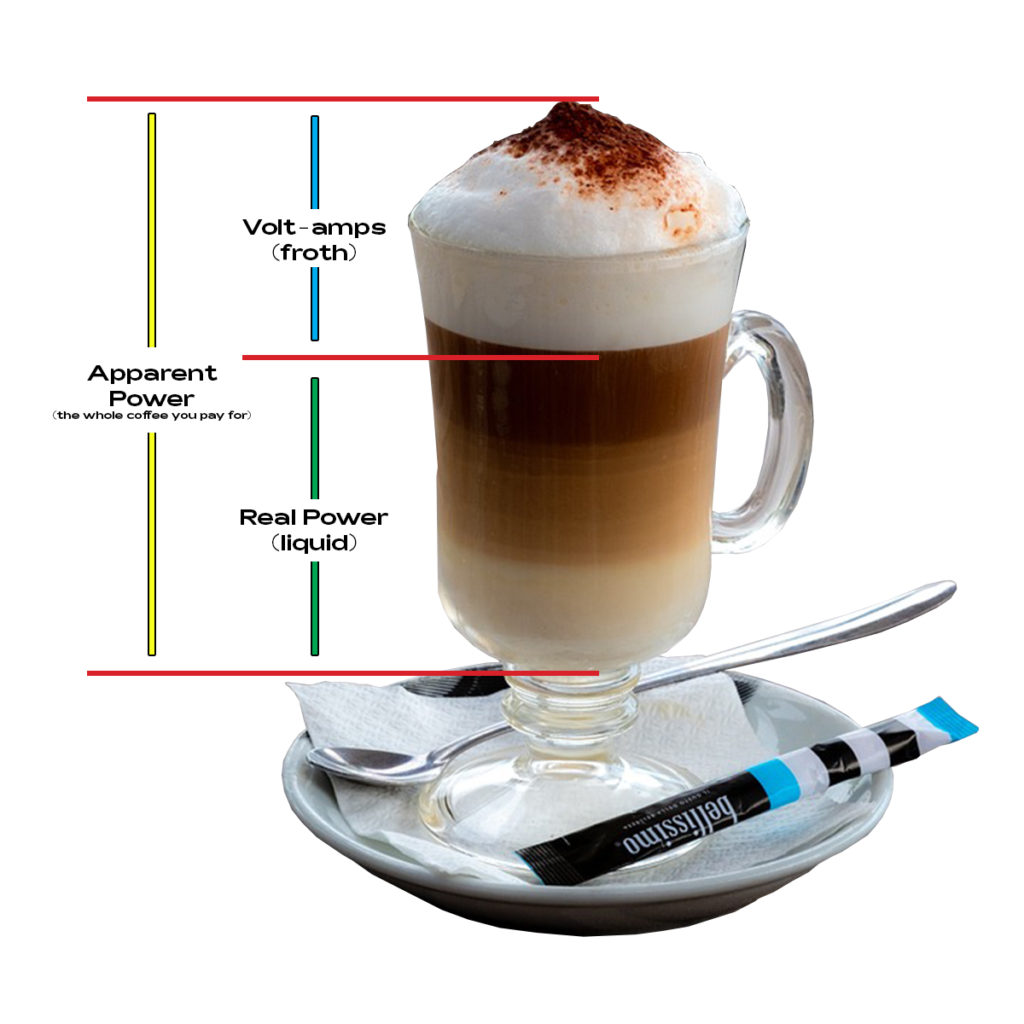
To begin with, PFC stands for “Power Factor Correction”. Generally, power factor can be kind of a complex topic. But in short, it is the ratio of real power to total volt-amps applied to the input of a load. Power Real / (Volts in*Amps in). For example, one way you could imagine power factor is to describe it in terms of a latte. First off, imagine the whole latte – froth part and liquid part – as apparent power (measured in Volt-Amps). Next, the froth is the reactive power (measured in Volt-Amps Reactive). Lastly, the liquid part is the real power (measured in Watts). Therefore, the power factor is the ratio of liquid (real power) to the total cup (Apparent power). In terms of power we want as much of the good stuff as we can get. Which is obviously the caffeinated liquid – the real power in a latte.
Ultimately, the purpose of Power Factor Correction is to achieve a “Unity” power factor, a power factor of 1. In other words, all of the power going into a system – or the power supply in our case – is real power. Subsequently, there are two forms of PFC – Passive PFC and Active PFC.
passive pfc
Why You Need PFC (Power Factor Correction) In An Amplifier
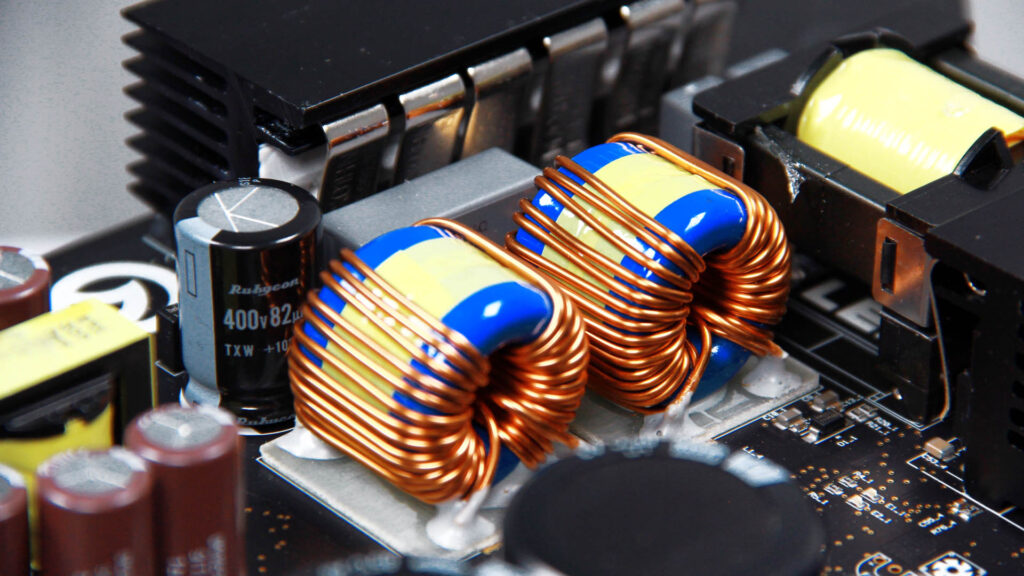
Passive PFC means there are only passive components (inductors and capacitors) to improve the power factor (move it back toward unity).
active pfc
Why You Need PFC (Power Factor Correction) In An Amplifier
Generally, there are a lot of different ways to do Active PFC. However, they all have one thing in common. Namely, they all use “Active” controls, analog or digital. In addition, they have high-frequency power electronics. As a result, this makes the input of a power converter look like a resistor. In other words the current is in phase with the voltage. Additionally, current is drawn more linearly, with the rise and fall in voltage across the full line cycle.
So why do i need pfc in my amplifiers?
Why You Need PFC (Power Factor Correction) In An Amplifier
For starters, Active PFC is one way to achieve a universal input power supply. There are two main voltage and frequencies that are used for AC power distribution in the world: ~115V 60Hz and ~230V 50Hz. Universal input means the power supply can accept any of these voltages without the user doing anything. Therefore, there is no need to flip a switch or order correct voltage version of a product.
Consequently, this is also important for systems around the world when it comes to AC voltage fluctuations (brownouts). For example, systems using amplifiers without universal input power are susceptible to voltage fluctuations during brownout conditions. Whether it be intentional load reduction in emergency circumstances or unintentional disruptions of an electrical power grid. In particular, these units aren’t built to handle those extreme voltage ranges and will automatically adjust and produce a regulated output. With universal input power, the acceptable voltage range becomes much larger and those systems are able to remain operational.
Furthermore, a universal input power supply also gives the flexibility of using single phase power or dual phase power (for systems located within the U.S.). In addition, from a manufacturer’s standpoint, it simplifies production processes by eliminating the need for multiple skews.
Beyond that, PFC also reduces the line harmonics, distortion and peak currents in the input stage. This all adds up to a power supply that distorts the AC Line less. In other words, it is less likely to cause problems with other equipment plugged into the same AC line. Simply put, less distortion and smoother operation.
how does Power Factor Correction work?
Why You Need PFC (Power Factor Correction) In An Amplifier
To begin with, Passive PFC improves the power factor by using passive components, such as L’s, R’s and C’s, to bring the power factor close to unity. For those who aren’t privy to the lingo, L’s are inductors, R’s are resistors, and C’s are capacitors.
Conversely, in Active PFC designs, the active controls try to force the input to look like a resistive load to the AC line. Active PFC uses high-frequency switching power electronics and controls to force the current to follow the voltage. Voltage = Current * Resistance. So, the voltage and current are in phase and the power drawn is “Real” power.
Incidentally, the type of PFC we are using for LEA products is Active PFC. We chose Active PFC over Passive because, Active PFC has many advantages over Passive PFC, such as:
1st – Provides universal input and produces a regulated output voltage. 2nd – Active PFC is smaller and lighter, more so as power goes up. 3rd – It’s able to achieve unity power factor across a wide load and input range. 4th – Active PFC can reduce input current harmonics.
Furthermore, the power supply we’ve designed for our Connect Series amplifiers is a single-stage interleaved PFC power supply. PFC and isolation stage (normally two separate power stages) merged into one stage with this type of supply. Consequently, this makes the design smaller, more efficient and cheaper for the power level.
conclusion
Why You Need PFC (Power Factor Correction) In An Amplifier
In conclusion, power amplifiers that use PFC present several benefits over those that don’t. PFC helps to reduce costs by pulling less reactive power, increase acceptable voltage range to ensure universally clean operation around the world, and reduce unwanted distortion for friendly and clean power.
If you have any questions or feedback about PFC or our CONNECTSERIES amps, feel free to leave them in the comments below or reach out to us on our social media channels.
Want more LEA content delivered directly to your inbox? Enter your email address below to be subscribed to our monthly newsletter and keep up with all of the latest news and content from LEA Professional.
A second-order benefit not mentioned is that PFC eliminates or greatly reduces circuit breaker nuisance tripping. Switching amplifiers rated at several KW of total power tend to experience nuisance tripping of the (typically 20A) breakers, especially in mobile applications that run off a generator. Utilizing PFC reduces peak currents and in many cases greatly reduces or eliminates this issue.
I believe US split-phase power is being called dual-phase in this article. It’s a common misconception that U.S. split-phase power is dual-phase/two-phase. It is not. Both 120V legs are in-phase and not 180 degress out-of-phase. They may appear to be 180 degrees out-of-phase with respect to the center-tapped neutral when viewing certain representative diagrams, but they are indeed in-phase. They must be to be additive.
-180 degrees is just an alternate way of expressing 0 or 360 degrees.
Hi Marc! Thanks for the comment. We’re always happy to discuss these things! Hopefully, this will elaborate a bit more:
A split-phase or single-phase three-wire system is a type of single-phase electric power distribution. It is the AC equivalent of the original Edison three-wire direct-current system. Its primary advantage is that it saves conductor material over a single-ended single-phase system, while only requiring a single-phase on the supply side of the distribution transformer.[1]
The two 120 V AC lines are supplied to the premises from a transformer with a 240 V AC secondary winding which has a center tap connected to ground. This results in two 120 V AC line voltages which are out of phase by 180 degrees with each other. The system neutral conductor is connected to ground at the transformer center tap. 240 V AC can be obtained by connecting the load between the two 120 V AC lines.
Other applications of a split-phase power system are used to reduce the electric shock hazard or to reduce electromagnetic noise.
Comments are closed.
This website uses cookies to improve your experience. We'll assume you're ok with this, but you can opt-out if you wish.AcceptRejectRead More
Privacy & Cookies Policy
Privacy Overview
This website uses cookies to improve your experience while you navigate through the website. Out of these, the cookies that are categorized as necessary are stored on your browser as they are essential for the working of basic functionalities of the website. We also use third-party cookies that help us analyze and understand how you use this website. These cookies will be stored in your browser only with your consent. You also have the option to opt-out of these cookies. But opting out of some of these cookies may affect your browsing experience.
Necessary cookies are absolutely essential for the website to function properly. This category only includes cookies that ensures basic functionalities and security features of the website. These cookies do not store any personal information.
Any cookies that may not be particularly necessary for the website to function and is used specifically to collect user personal data via analytics, ads, other embedded contents are termed as non-necessary cookies. It is mandatory to procure user consent prior to running these cookies on your website.

















































A second-order benefit not mentioned is that PFC eliminates or greatly reduces circuit breaker nuisance tripping. Switching amplifiers rated at several KW of total power tend to experience nuisance tripping of the (typically 20A) breakers, especially in mobile applications that run off a generator. Utilizing PFC reduces peak currents and in many cases greatly reduces or eliminates this issue.
Great addition, Bob. Thanks!
I believe US split-phase power is being called dual-phase in this article. It’s a common misconception that U.S. split-phase power is dual-phase/two-phase. It is not. Both 120V legs are in-phase and not 180 degress out-of-phase. They may appear to be 180 degrees out-of-phase with respect to the center-tapped neutral when viewing certain representative diagrams, but they are indeed in-phase. They must be to be additive.
-180 degrees is just an alternate way of expressing 0 or 360 degrees.
Hi Marc! Thanks for the comment. We’re always happy to discuss these things! Hopefully, this will elaborate a bit more:
A split-phase or single-phase three-wire system is a type of single-phase electric power distribution. It is the AC equivalent of the original Edison three-wire direct-current system. Its primary advantage is that it saves conductor material over a single-ended single-phase system, while only requiring a single-phase on the supply side of the distribution transformer.[1]
The two 120 V AC lines are supplied to the premises from a transformer with a 240 V AC secondary winding which has a center tap connected to ground. This results in two 120 V AC line voltages which are out of phase by 180 degrees with each other. The system neutral conductor is connected to ground at the transformer center tap. 240 V AC can be obtained by connecting the load between the two 120 V AC lines.
Other applications of a split-phase power system are used to reduce the electric shock hazard or to reduce electromagnetic noise.